
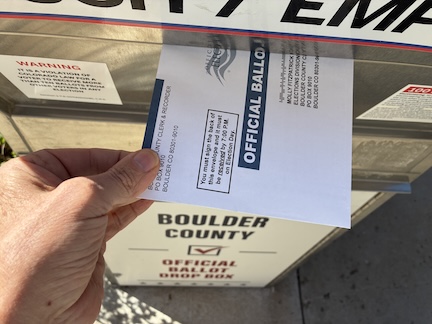
I just popped my ballot into this box. No waiting, no hassles. No thoughts of “how I wish I could wait in a long line instead.”
I voted just the other day. I got my ballot in the mail, filled it out in like two minutes, walked a block to a drop-off box, and dropped off my ballot with literally zero waiting. Whew!
Why anybody would want any other system is beyond me. It’s been more than 15 years since I stood in long lines at a polling place on one Tuesday out of the year. Why needlessly waste time like that when vote-by-mail is so simple and fast? Furthermore, it hasn’t always been easy for working people to justify long waits to vote on one given Tuesday in November, well within the typical American working week.
Unfortunately, I do have suspicions as to why people might politically want to go back to the old days of voting in person on one Tuesday in November. One is that it’s very easy to vote under Colorado’s all-mail* system, and that has meant this blue state tends to put up very high voter turnout percentage numbers – in 2020, we were second in the nation, only behind the Great State of Minnesota.
I put an asterisk by “all-mail” because voters do not need to use the mail for all parts of the voting process, or even at all if they choose to opt-out. Voters are completely free to vote in person at a clerk’s office or vote center. Voters can get their ballot in the mail but return it by hand to a drop box, like I almost always do. But beyond that, every registered voter gets a ballot mailed to the address listed on their registration weeks ahead of the election deadline, so there are very few legitimate excuses (beyond apathy) for not voting at all.
So, here’s Article I from my “world’s shortest manifesto” about voting. Every person who meets legal requirements should be able to vote, and it should be easy to do so. And for Article II – There should be more mail elections in the U.S., not less.
But it’s 2025, and like seemingly everything else I appreciate, mail voting is under attack. I was disappointed but not surprised when President Trump said he intended to sign an executive order that included a goal of ending vote-by-mail, just days after he said Russian President Vladimir Putin told him, “You can’t have an honest election with mail-in voting.” And here’s a quote directly from Trump – if you believe National Public Radio, ABC, CBS, The Hill, Brennan Center for Justice, and a bunch of other outlets that paraphrased some version of the following:
“We as a Republican Party are going to do everything possible that we get rid of mail-in ballots. We’re going to start with an executive order that’s being written right now by the best lawyers in the country to end mail-in ballots because they’re corrupt.”
Fortunately, the executive order hasn’t happened yet, and a legal scholar quoted in the NPR story I linked said, “He can’t just decree that we don’t have mail-in balloting anymore. The Constitution says that each state gets to set its own rules for running elections.”
Oh, the Constitution. How quaint. But Colorado has used its legitimate legislative process to establish its own very good statewide system. I was working at the State Capitol in Denver in 2013 when the legislature passed House Bill 13-1303, which not only set up our mail ballot system but also required a statewide network of voter service centers; allowed voter registration up until “Election Day;” and eliminated an “inactive” classification for people who didn’t vote in previous elections so these voters would get a ballot in the mail.

Putting the ballot in the box is just one part of the process. Before it’s in, election officials are managing voter rolls, and once it’s in, election officials do all kinds of work to make sure it’s a valid ballot.
So, Colorado set up a great system where it’s easy to vote and almost all registered voters should have basically the same opportunity to participate. But is it secure? Before trusting a politician with 34 felony convictions who once asked a Secretary of State to “find” 11,780 votes for him, or Vladimir Putin, I’ll recommend actually learning about the rigorous safeguards already in place.
Colorado election officials must follow not only state laws and rules, but also federal standards including the National Voter Registration Act (NVRA) and Help America Vote Act (HAVA). This story from Rocky Mountain PBS is a nice, easy way to start learning more about Colorado mail voting safeguards, but here’s a little primer:
- Signature Verification: Voters must sign and date their mail ballot envelope, and elections officials check these signatures against signatures they have on file as a safeguard. If the signatures don’t match, or if there’s no signature, election officials notify the voters and they must take action to fix the discrepancy or the ballot won’t count. I will vouch that I’ve seen post-election lists of local ballots with signature discrepancies, so officials do in fact check signatures. Election geeks can read the section of state law detailing signature verification procedures at this link, but verification very clearly happens and people found forging signatures will face legal penalties.
- The Dead: No, not the band. People can and do die during election cycles, but there are safeguards in place to determine if a voter or a ballot is legitimate. U.S. states are required under HAVA to cross-reference their voter rolls with data from state death records, and death records have a date of death. In Colorado, the Secretary of State’s office receives information about potential deceased voters from U.S. Social Security and the state Department of Public Health and Environment. Voters will be removed from voter rolls if their death has been officially determined. And if a person legitimately votes before they die, the vote will count if their returned ballot was signed and dated before the date of death. It’s sort of funny, but while I was writing this piece, a Colorado Republican woman was convicted of voting her dead husband’s ballot, and elections officials caught her because they were checking voter records like election officials are required to do.
- Non-Citizens: People must be legally registered voters to receive a mail ballot, and people have to be citizens to be legally registered. First-time mail voters must produce at least one form of acceptable identification with their registration, like a driver’s license, state-issued ID, or passport. Voters must affirm that they are citizens on their registration form, and election officials will check for license or Social Security numbers to verify. And if a non-citizen is caught voting illegally, the PBS story said potential consequences are severe: “a fine, jail time and deportation.”
- Out of State or Out of District?: In Colorado, HB 13-1303 required the Secretary of State to conduct National Change of Address database searches on all registered voters, and to transmit the results monthly to county clerks. Before 1303, this search was required, but only quarterly. And a hint to Colorado voters – they should also update addresses on their voter registration if they move, to make sure ballots are sent to the right address, and these address updates also become part of voter rolls.
There is so much more people could learn if they have the time, but election officials in Colorado jurisdictions do tons of work to make sure mail elections are honest and trustworthy. Plus, top election officials including County Clerks and Secretaries of State are elected themselves, so these elected officials have great incentive to run the squeakiest-cleanest elections possible – if they want to keep their jobs, avoid discrediting their reputations, and in extreme cases stay out of jail.
In short, elections offices clean up the voter rolls, they disqualify people if they’re not legally eligible, and they do these types of things year-round – not just around election time.
Meanwhile, Colorado voters don’t have to take time off from work to vote on one Tuesday out of the year, we can almost always avoid long voting lines entirely, and we can research candidates and issues after getting our ballots at home – as opposed to trying to figure stuff out in a voting booth while others are waiting behind them to vote. Again, there should be more mail elections in the U.S., not less.
Democracy or Republic? Doesn’t Matter, They’re Both in Trouble
I’m just touching on a pet peeve of mine here. People might say this administration is a threat to our democracy, while others might say “we don’t have a democracy, we have a republic.” Never mind that nearly every type of political election in America is done through straight democracy – this administration is a threat to our republic as well.

Redistricting could be about this simple – sensible boundaries, a smaller district where the largest city is – but the quest for political advantage has made it much more complex.
Take Congress, please. In fact, partisans are literally trying to take Congress in 2026 through partisan mid-decade redistricting schemes. It pains me to watch from a distance, because there’s nothing altruistic about it. It’s all being done for naked partisan gain.
Texas has captured most of the attention for what it’s trying to do, but it’s important for everyone to know that it’s being done under pressure from the sitting President to help perpetuate his political power, and it’s being done to help Republicans capture perhaps five extra seats in what could be a tight race for control of the U.S. House of Representatives.
I’m sorry, this is dirty pool. I just watched the former Republican National Committee chair Michael Steele on TV literally calling it “cheating.”
Yes, California might follow suit, but I’d argue it’s a defensive move only to counter Texas. And other state legislatures are considering mid-decade redistricting, including at least (according to this PBS story) Missouri, Indiana, Kansas, Utah, Ohio, Louisiana, Maryland, Florida, New York, and Illinois.
They’re also trying to do it in North Carolina, and if you’re still guessing why, try this quote from a North Carolina state legislator:
“We are doing everything we can to protect President Trump’s agenda, which means safeguarding Republican control of Congress,” said North Carolina Senate Leader Phil Berger, a Republican from Rockingham.
So, is there a fairness reason for North Carolina to redistrict? It doesn’t appear that way to me, since Trump won its 2024 election by 50.86% – Harris’ 47.65%, but Republicans hold 10 of the state’s 14 seats in the U.S. House – or 71.4%, more than 20 percentage points above Trump’s performance. That’s as it stands today, even before a proposed highly partisan redistricting. Do Republicans deserve an even greater advantage in what otherwise appears to be a swing state?
Still, mid-decade redistricting doesn’t appear to be illegal or unconstitutional, but maybe that needs to change. At least two bills are being proposed in Congress right now – one from a California Republican who has to understand what a high-quality Democratic-proposed redistricting could do to California Republicans, and maybe even to his own seat in Congress. Another bill was introduced from two California Democrats, with a ban on mid-decade redistricting only a part of a longer bill.
Of course, both bills are dead in the water as long as we have Republican control of both the House and Senate and a President who wants nothing more than any sort of partisan or personal advantage he can get out of anything. But these bills at least show that some legislators understand we have a problem.
I’ve been through several rounds of congressional redistricting at some level, including working as a staffer for a co-chair of the Colorado congressional redistricting committee after the 2010 census. I would not call myself a top-level expert, but I’ve worked with redistricting maps, attended redistricting hearings in at least four congressional districts, and fielded input from people across the state.
I do know from experience that redistricting (done fairly) is a massive undertaking that should involve public input and public process, because results very literally impact the public. It’s usually done as soon as practical after each Census, and one of the top goals is to create districts roughly equal in population, especially important if a state’s population changes significantly over the course of 10 years. Then, typically (but not always) these districts are left the same until the next Census, and that’s the way it should be short of dire emergency or legal decisions. It’s good for stability – residents shouldn’t have to constantly have their districts changed, and even the legislators ought to be able to count on the districts they were elected by the people of that district to represent staying the same for a while.
But what we’ve got going on now is about as purely rotten as I’ve seen in my 50 years of following politics, at least when it comes to redistricting. My hope is that perhaps Texas will stand down (ha) or at least lose in court, and the redistricting plan is in court now, as of late October 2025. If Texas’ redistricting doesn’t go forward for whatever reason, maybe this whole domino effect of other states doing it wouldn’t need to happen. It’s been a disgraceful episode so far, but I’ll keep holding on to some probably-naive hope for a fair ending.
I actually wanted to touch on more things that worry me about elections at this time, but between mail ballots and redistricting I think that’s enough for one post. Still, I do want people to know about some of these things, even if the info doesn’t come from me. For those who are watching with Halloween-level horror as Project 2025 unfolds in real time – yes, it has components that could badly impact the elections systems many of us have lived under for most of our lives. For a one-stop-shop, try this link from the Brennan Center for Justice which includes analyses of how Project 2025 might affect issues like elections cybersecurity, elections disinformation, and attacks on election officials. And make sure you’re sitting down while reading.
Once upon a time, I remember learning about an America that could export democracy to other nations; an America with checks and balances to prevent abuses of power. It was always somewhat of a rosy way of looking at a complex world, but the bloom is now officially off the rose as far as I can tell. I can only hope we will start planting seeds ASAP that might eventually help bring back a nation with the checks and balances we need for a fair democracy and a fair republic.


