
I just finished participating in my local Democratic Party precinct caucus, the Congressional District 2 Assembly, and the Colorado State Assembly. I’m quite proud of all of it, but my buzz of positivity gets harshed every year as people complain about caucuses for various reasons. I’m not going to say they’re 100% wrong, but I do think there’s lots of misunderstanding about the purposes and processes of caucuses and assemblies. Follow along, because I’d like to try telling the positive side of the story.
Precincts: Every Chunk of the County Gets Representation

Here’s the Boulder County precinct map, and Democrats allocated 2 or 3 delegates from every precinct for County Assembly in 2026.
What I call the “caucus-assembly process” begins every two years with precinct caucuses. The precinct is the smallest public political unit in Boulder County (I don’t count HOAs or neighborhood associations as public). Check out the map at right, which shows the 240 precincts in Boulder County.
One benefit of the caucus system is that every single precinct in Boulder County can get two or three delegates to the County Assembly, at least for the Democratic Party system I’m used to.
So, if you live in Ward or Allenspark or any remote unincorporated area, you can just find your local caucus site and run to become a delegate. There are no qualifications needed except being a registered party member, but people might have to convince fellow caucus attendees that they’re a good choice. And if caucus attendance at a rural site is small, attendees have a really good chance of becoming delegates.
This means every part of the county gets some representation at the next level, and I think that’s a great thing. You don’t have to be a Boulder or Longmont insider to be a county delegate, and that might even help certain types of candidates.

Nederland is just a blip on this map of the 2nd Congressional District, but the former Mayor of Nederland got 22% of delegates for CU Regent. He almost certainly earned delegate votes from people living in his town or area, thanks in part to all precincts being allocated delegates at the County level.
Take for example Kris Larsen, the former Mayor of Nederland who ran for CU Regent. People from Nederland or nearby mountain communities who probably know him personally could have become delegates through caucus and voted for him at the next assembly.
Larsen ultimately did not prevail at the Congressional District 2 Assembly, but he got 22% of the delegate vote despite not being from a major population base within the district. Surely some of his delegate total was from members of his local community who knew him and appreciated his service. He got about 25% at the County Assembly and I would assume most or all of these delegates voted at the Congressional District 2 Assembly.
We talk a lot about equity in these here parts, and getting rid of a system that gives all precincts in a county tangible representation at the County Assembly would be damaging to this specific type of equity.
The Human Dimension: It’s Real Good
Caucuses and assemblies are normally live meetings, and that means real people. The personal dimension is something we’re losing to a certain extent these days, with social media and Zoom meetings and artificial intelligence, and I don’t necessarily think that’s all good.
At precinct caucuses, you spend a couple hours in a room with your closest neighbors. I met new people during the meeting, and as importantly I got to hear what they had to say in a live setting. We exchanged ideas, asked questions, made jokes both good and bad, and you could glean passion or other emotions from actual human beings.
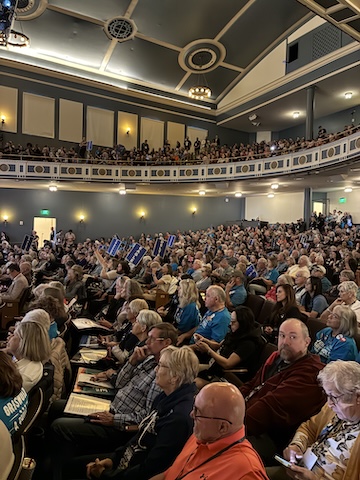
I was in Pueblo with more than 2,000 people for the State Assembly, and knew lots of them! It was a political event but also social to some extent.
In our broader area, something like a dozen precincts held their caucuses at a “supersite,” normally a school or public building with room to handle a larger gathering. Before the smaller precinct caucuses started, there was time for socializing, and then we went to an auditorium to hear speeches from candidates or their representatives. Again, real people. We met new folks or greeted old friends, plus learned more about candidates running for office from real humans – often from our general neighborhoods – speaking on their behalf.
Then, I got to spend time with real people at both the county and state assemblies, with one major difference from caucus. Since the county and state assemblies were each held in one building, there was a better chance of meeting and talking with the actual candidates who didn’t have to choose which caucus sites to visit. I personally met and talked with a bunch of them, some for the very first time. It was real personal contact with candidates who might ultimately be able to influence my quality of life – not a TV commercial, a website, or a piece of literature.
We have done caucuses and assemblies digitally in the past, especially during the beginning of COVID, but these meetings very clearly lacked the human dimension. A chat function on Zoom is just not the same as shaking someone’s hand and looking them in the eye. I could on occasion sacrifice the personal dimension to save time or avoid a potentially fatal virus, but in my opinion it’s not an ideal sacrifice when you’re dealing with a viscerally personal situation like selecting political leaders.
Repeat Often: Caucus is Not the Election
It really grinds my gears to hear people say caucus is “anti-democratic.” It’s like saying Taco Bell is “anti-Italian” because they don’t serve gnocchi bolognese. In both cases, they’re different things and should not be directly compared, or at the bare minimum caucus doesn’t deserve THAT pejorative. Caucus/assembly is a delegative process, in which the delegates ultimately select some of the candidates who will advance to the primary election. Delegate votes at assemblies are only about meeting a threshold – for the most part it takes 30% of delegates to qualify for the primary, and two or maybe three candidates can qualify this way.
Then, the actual democracy happens in June, when we have the primary elections. In the primary, every voter who’s registered with a major political party – or unaffiliated – gets a ballot in the mail to fill out at their leisure. That’s straight democracy, and it’s the official contest that decides which candidates move on to the November general election.
There is voting at caucuses, so to me there is some democracy, but the voting is only to select limited numbers of delegates for future assemblies. I was one of the roughly 500 delegates at the County Assembly, and in my opinion we couldn’t have fit many more delegates into the auditorium at Fairview High. I was also one of the 1,500-ish delegates at the State Assembly, and again it was plenty crowded for the size of the facility.
I’m not trying to minimize the possibility that a campaign might end if a candidate doesn’t meet threshold at an assembly. It’s harsh when that happens. But there is some responsibility for a campaign to try figuring out ahead of time if there’s a good chance they can qualify for the ballot through assembly. If it’s unlikely or iffy, they have another option, which is gathering perhaps thousands of petition signatures – so on to the next section!
Petitioning is Not Democracy Either

Petitioning is a legitimate way to get on a ballot, but do you really want more strangers knocking on your door with clipboards? I for one am fine putting some candidates on the ballot through caucus and assembly.
I’ve heard people talk about eliminating caucus and just having everyone petition onto the primary ballot. It’s a fair opinion, but if it’s your position, please don’t call caucus anti-democratic, because there’s really nothing democratic about petitioning. I’ve done it, and here’s my simplified version of a typical interaction.
“Hi, I’m (someone you’ve never met), and I’m gathering petition signatures for (maybe someone you know nothing about). This petition is JUST TO GET THIS CANDIDATE ON THE BALLOT. Will you sign?”
Chances are great that the person being asked to sign, whether at their front door or at the farmer’s market, wants to get this over as fast as practical. They might decide to sign or not based on their mood or activity at the time. In my experience, petitioning only very rarely is a deep exchange of information. Petition gatherers have numbers to hit, and a lot of people being asked for signatures find it annoying, so both sides typically want to get it done fast and move on.
In my opinion, petitioning is a legitimate way to qualify for a ballot, but I question whether it’s a great indicator of political support. This is especially because campaigns with money can just pay firms to gather petitions for them. Nothing against the people who do this fairly hard work (one of my favorite people works in this field), but petition gatherers rarely care deeply about a candidate, and they’ll gather petitions for anyone who can pay them.
To me, one benefit of caucusing is to reduce somewhat the amount of petitioning. The popular incumbent with no opposition can just run at caucus and qualify for the primary, without burning out volunteers who gather petitions or spending finite campaign money on paid petitioners. That’s also a few thousand fewer unsolicited knocks on peoples’ doors, or fewer people with clipboards targeting you for nothing but a signature at the farmer’s market. Perhaps in the future there will be more widespread digital petitioning, in case Evan from Heaven is reading, but for now Colorado is largely dealing with paper petition books, dark ink, and clipboards.
And by the way, for those who criticize caucus for being “antiquated,” petitioning might have begun thousands of years ago when slaves building pyramids in Ancient Egypt petitioned for better working conditions. Some things will never change. Democracy is also several thousand years old (Ancient Greece). Caucus haters need a better buzz-word, in my opinion.
Big Difference Between Can’t Attend and Won’t Attend

In 2016, I ran a Boulder precinct caucus and had to fit 220 people into half of a middle school library. That’s because many people were motivated to attend caucus and support Bernie. People “can” attend caucus.
Caucuses and assemblies are live meetings, which by definition means some people can’t attend at that given time, and that’s unfortunate. However, I can’t prove this but I strongly suspect the numbers who “won’t” attend are vastly higher than those who “can’t.”
Our 2026 precinct caucus was held on a Saturday afternoon, when many people working a Monday-through-Friday work week have the day off. We used to do Tuesday evenings, and apparently Boulder County Republicans still do, when many people who work 9-5 jobs could grab a bite to eat after work and head to their local caucus.
I don’t mean to be insensitive to anybody, but since caucus is part of a delegative process (right?), the attendance numbers just don’t represent the same value as voting numbers do in a typical election. Our precinct got three delegates whether we had 13 attendees (like we did in 2026) or if 220 would have showed up (which happened in the Bernie year of 2016). And the gigantic turnout in 2016 sort of proved to me that people “can” attend caucus if they’re motivated.
I just can’t say that we should have a reasonable expectation of huge caucus attendance every two years anyway. Even for the 2022 primary election, statewide turnout was only about 32% of active voters, when every registered voter got a ballot in the mail and nobody had to leave home or even put on clothes to vote. If people would rather go hiking on a Saturday afternoon than attend caucus, that’s fine but let’s not pretend it’s not a conscious personal choice.
A Few Final More Gears to Grind

I met Boulder County D.A. Michael Dougherty for the first time in person at the State Assembly. Three hours later I was on the main stage waving his sign while he spoke. All I really did was show up.
The caucus is open to every party member who lives in a given precinct. I’ve heard that it skews too much toward older people, but I’ll ignore the ageism for a second to reiterate that anyone legally qualified can participate. For young people in Boulder County, there are literally precincts that include the CU campus or student-heavy off-campus areas. I wasn’t that interested in caucus either when I was young, but the opportunity was still there every two years, and nobody would have turned me away if I would have just gotten out of bed and trudged to a walking-distance caucus location. It asks nothing more than spending about two hours every two years.
Could we tweak caucus? I’m sure it’s possible, but I wouldn’t get rid of the core structure. I firmly believe that the live personal dimension is better than digital if we have a choice. It’s better and fairer in my opinion to have geographic precinct representation for all corners of a county. I think it’s important that we don’t have too many candidates reaching the ballot, and caucus/assembly thresholds can help winnow down the numbers. Petitioning is always available as an option, but it takes work and/or money so it’s a legitimate indicator of a serious campaign.
But at some point, a political party has a right and obligation to function as a political party. I got together with my fellow party members three times this month, in each case discussing issues and personalities that might make real differences in our lives. And it’s something I enjoy. If anyone doesn’t like caucus or even belonging to a political party, that’s fine, and if they’re properly registered they can still cast a vote that actually counts during the June primaries without ever participating at all in political party processes.
I know there are far bigger issues in the world right now, but just wanted to vent. And chances are good anyone who shows up will see me at caucus two years from now. Life will go on for me if caucus goes away, but it won’t go away until somebody comes up with a high-quality new idea that honestly factors the possible negatives of getting rid of a familiar system that actually works. I’m not holding my breath.


